


 42 / 72

Old German Owls – Page 42 – Purebred PIGEON
B
reed of
the
I
ssue
- O
ld
G
erman
O
wl
Ash Red
Old German Owls
By Leonard Kuzminski
Ash Red is number one in dominance in color of the three base colors in pigeons.
It can be a soft lavender color to a brilliant deep blood red. I really love this color in
pigeons but you have to be careful because it will overrun your loft because of its domi-
nance. It can be controlled if careful breeding techniques are used. In Europe where
the Old German Owls originated, German breeders are masters at their craft breeding
great colors and birds.
A lot of German breeders will keep birds that complement one another. For exam-
ple with red bar, they will keep red bar, red check, yellow bar and yellow check. All four
of these complement one another and can be crossed to one another without any ill
affects. Or they might go with just one color. Red T- pattern saturated in color is also
ash red. German breeders usually don’t have the space or property to have huge lofts.
Space is very limited so they must keep a limited amount of birds, and the quality of
the birds there are usually very good in color and quality because they keep the best of
the best.
I have a weakness for breeding Old German Owls. I like all the colors but I’m going
to narrow down to the ash red color. In my loft right now I have T- pattern ash reds, red
check, red bar, yellow check and spread ash red. I usually keep my ash red birds bred
to the ash red, but occasionally I will cross a blue bar or a blue check to my red birds.
I’ve put blue bar on dilute ash red color yellow check and get yellow bar, yellow check,
silver check, silver bar, blue bar and blue check babies. You can see how many different
combinations you can get just out of those two birds.
One other thing that I’d like to mention: Ash red is sex-linked which means ash
red hens that are mated to any blue factored birds, or brown factor birds will produce
all ash red color cock birds. Whatever color the cock bird was in the mating will pro-
duce that color in hens. For example: if I mate a blue bar cock and a red bar hen, I will
get blue bar hens and red bar cock bird youngsters that ares produced in this mating.
Now if you do the opposite and put a red bar cock mated with a blue bar hen, you
should get all red bars from this mating. The cocks that are produced from this mating
can carry blue. There’s other things that come into play with this, for example: if the
cock bird carries dilute. That’s another whole thing that comes with breeding birds.
The cock bird carries two color genes. The color he is and also a color that is hidden
which could be dilute.
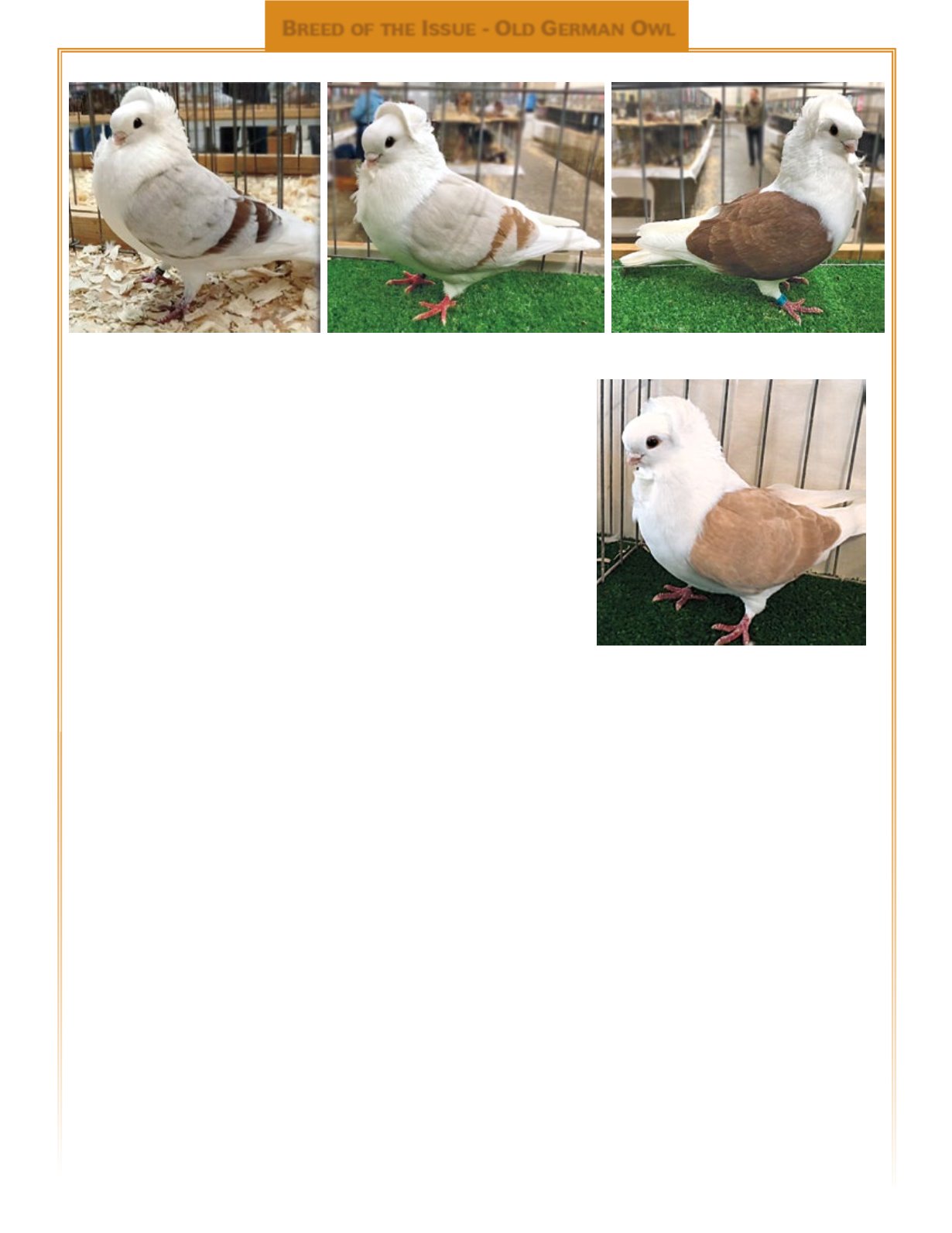
Red Bar cock - Bred by Len Kuzminski
Yellow Bar Dilute Cock - Bred by Kelly Baumgarter
Red T-Pattern Cock - Bred By Len Kuzminski
Yellow T-Pattern Dilute Hen - Bred By
Len Kuzminski
These are just a few things that ash red can
do in your loft. I have to remind you I am not a
geneticist or a Genetics expert. Just a guy that
likes to raise pigeons and show them for enjoy-
ment. I would just like to mention there’s quite
a few people working with the ash red color in
Old German owls.
Some very good deep colored birds are
coming from lofts here in the OGO Club. I
personally have imported birds from Germany
and a red shield marked from John Redman
of Canada who originally imported birds from
Germany. I also have red birds that came from
Chet Edmunds. I know that Jay Turner, Jeff
Wozniak, Bob Perkins among others who have
imported reds in shield, bar and in check from
Germany. On the West Coast Chet Edmunds is
working very hard to get a very deep colored
red birds introduced into the Old German Owls.
I noticed in Louisville at the 2019 NYBS, the
red class was very competitive. There were very
good colored red shields. The class was won by