


 43 / 72

Old German Owls – Page 43 – Purebred PIGEON
B
reed of
the
I
ssue
- O
ld
G
erman
O
wl
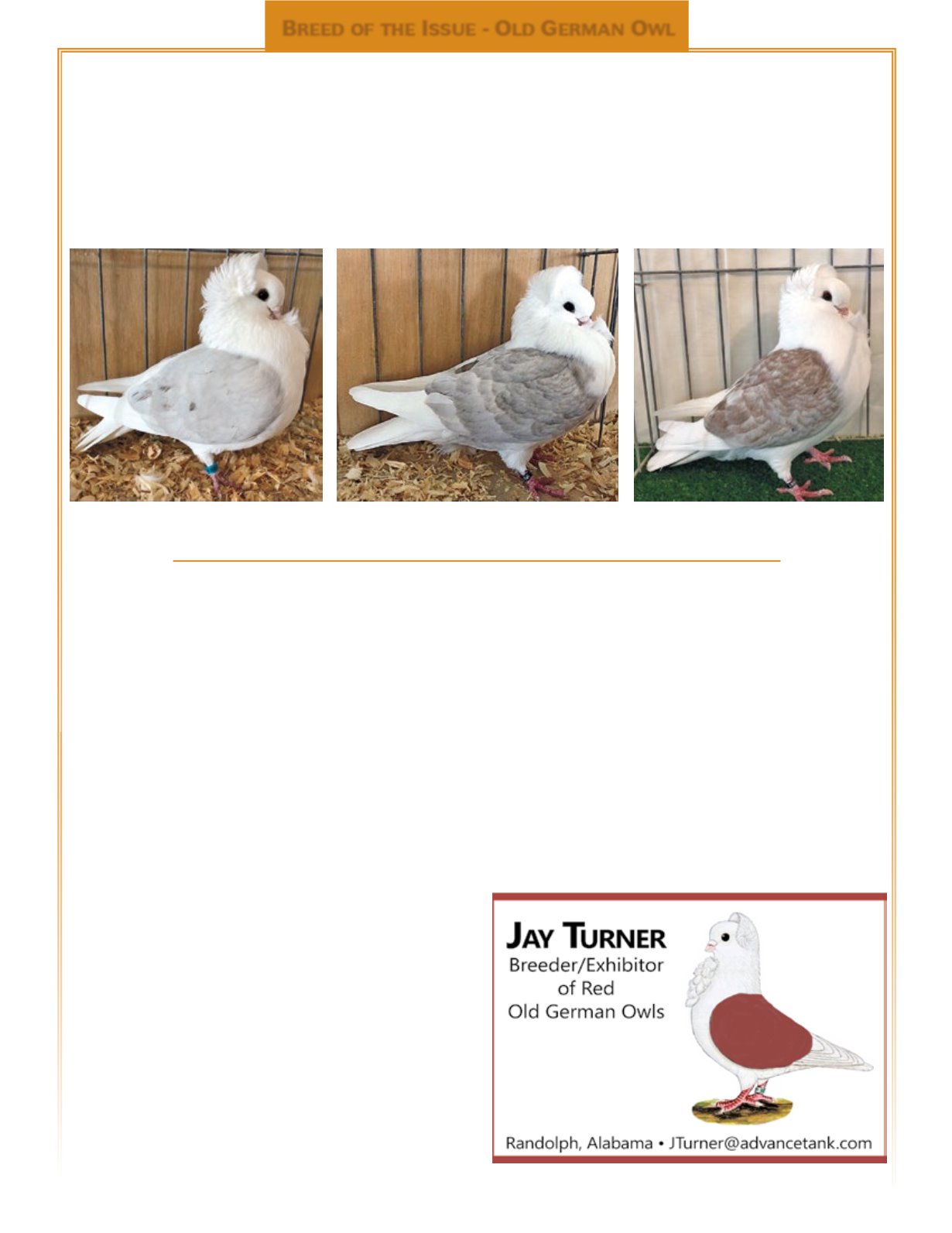
Spread Ash Cock - Bred By Len Kuzminski
Spread Ash Hen - Bred By Len Kuzminski
Spread Ash Hen - Bred By Len Kuzminski
Forrest Malcolm. The color has become very intense in this class in
the last two years.
Last but not least we have Spread Ash. This is the ash factor
combined with spread. What spread does is that it takes the color
and spreads it out, but with Ash red it does something a little dif-
ferent. It gives it a lacing on the wing shield or you can possibly get
soft colored ash or lavender bird. There’s a few pictures I’m going
to add to this article to show you the differences with ash red. I
also have a had a few pictures of ash red in the dilute factor. Which
would be yellow bar and as old-timers would call it cream bar, also
yellow check pattern. At this time I don’t have any deep colored
yellows. I hope you enjoy the pictures of Ash red.
(The last three pictures below) show the differences in spread
ash from light to dark pattern.•
May They All Be Red
By Jay Turner
I
have always been a fan of red pigeons, in fact, red mottled
pigeons are my all-time favorite of all colors and I still breed
them in West of England Tumblers.
For the most part, any combination of red and white in
pigeons has all ways caught my eye. For many years I had red
baldhead Show Rollers then I moved on to red baldhead West of
England Tumblers, then later it would be red self West then red
mottle West. As you see a marked bird that is red in color can
seem to find its way into my loft.
So a few years ago a couple of my friends encouraged me
to get into Old German Owls and of course I asked if they came
in red? The Old German Owl is a great little pigeon with a great
attitude and spunky spirit so if I could find them in red I would
be set. My good friend Jeff Wozniak helped me with importing
some birds from Germany about three years ago. From there
I purchased a red cock and a yellow hen; a year later I would
acquire another red import hen and these three birds would be
the base for my family of red Old German Owls. The color and
the markings is great in these three birds, however they lack in
body and type, and they seem longer and have less body than the
American birds. So to the rescue comes my best bud Bill Hender-
son who had just what I needed, a red t-pattern young cock that
he felt was one of the best OGOs he had bred at the time, perfect
for what I needed.
So I have started a family around these four birds plus a
couple from some other friends that I think will help out; it’s just
a start but I think it will be a lot of fun. Last year I raised about
20 and this year I plan to raise 30-40 focusing on mainly just reds
with a few yellows from time to time. It is so nice to walk into
my loft and see 20 or 30 red OGOs that are all marked alike with
great color.
The Old German Owls are special little pigeons with a great
support club in our country, I think they will continue to see
great growth and improvement if they keep up the good work. •