


 36 / 72

Old German Owls – Page 36 – Purebred PIGEON
B
reed of
the
I
ssue
- O
ld
G
erman
O
wl
Breeding the
Modern
Old German Owl
Bill Henderson
T
he use of both the words, Old and Modern, in the title
of this article would seem a contradiction but in reality,
I feel that it is the best way to describe the Old German
Owl that is being bred today. I will endeavor to explain what I
mean.
I first came into the breed ten years ago, purchasing a pair
of Red Bar Shields from Greg Pola while attending the Lakeland
NPA Grand National. I was very involved with West of England
Tumblers at the time but had started having issues with Pigeon
Lung. In the back of my mind, I was starting to consider giving
them up because of using a litter to keep their muffs in shape
for a show season. Although I hung in there with the West a few
more years, I was eventually forced to let them go and concen-
trated on the Owls. Over the time I had both breeds, the Owls
had really grown on me because of their personality and with
the shield markings, they were just so attractive in the loft.
During the years that I had both breeds, I was primarily
interested in showing and competing with the West. The Owls
were fun in the loft but did not have a strong presence in the
show room, so basically, I bred them for my own enjoyment.
Consequently, I selected birds of a certain type and style that I
wanted to look at every day. As I got more interested in them,
I tried to add some additional birds to my breeding program.
However, this proved quite difficult; the type of bird I wanted
was very scarce. The breed had suffered a drop in popularity;
issues with the parent club and several of the stronger breeders
had either left or their interest was very low. Consequently, good
stock was very hard to come by. There simply weren’t many Old
German Owls to be found, let alone purchased. At that time,
most of the birds were long in body, had low set crest with poor-
ly formed rosettes and most stood with their heads tucked and
tails high above the floor.
Fortunately, we are now seeing far less of this type of bird
and more of an upright, short and stylish one. This type of bird
has proven far more appealing and is evidenced by the increase
of interest in the breed from both new and returning breed-
ers. Good birds are still hard to come by but at least there are
proportionately more available because there are so many more
active breeders. In just the past couple of years, we have seen a
large number of well-established breeders from other breeds,
many of them Master Breeders, develop an interest in the Old
German Owl. Competition is at an all time high and should only
get better in the future.
Not only has the breed been somewhat transformed, the
parent organization, The Old German Owl Club, has also un-
dergone some change. There have been changes to the bylaws,
plus a new standard clarification; both helping to better address
the needs of the breed and the club. The original standard was
translated from the German standard and, consequently, some
of the wording and structure, needed to be clarified, making the
standard easier to understand. Color classes were also addressed
and there are a number of breeders that are establishing new
colors within the breed. Additionally, some are taking more in-
terest in developing the self and tailmark varieties, so the future
looks quite promising.
Besides the standard update, the push for using breeder
judges at the major shows across the country has had a signifi-
cant impact on the breed and the quality of the birds exhibited.
Knowledgeable breeders that are willing to take on the challenge
of judging are invaluable to the continued improvement and
growth of our breed.
The first NYBS I exhibited an Old German Owl in was 2012
and there was a total entry of two birds, they were put in the
Rare Breeds section. This past NYBS, we had an entry of 184,
quite a change in just nine years. That kind of growth and inter-
est is a great indication of where this breed is heading and the
positive changes that have been made.
The modern Old German Owl is a delightful pigeon, colorful
and naturally tame. For the most part, they do a good job of
rearing their own young, are not especially aggressive and pres-
ent quite a great challenge to the most accomplished breeder.
Do what I did, add a pair or two to your loft and you will be glad
that you did.•
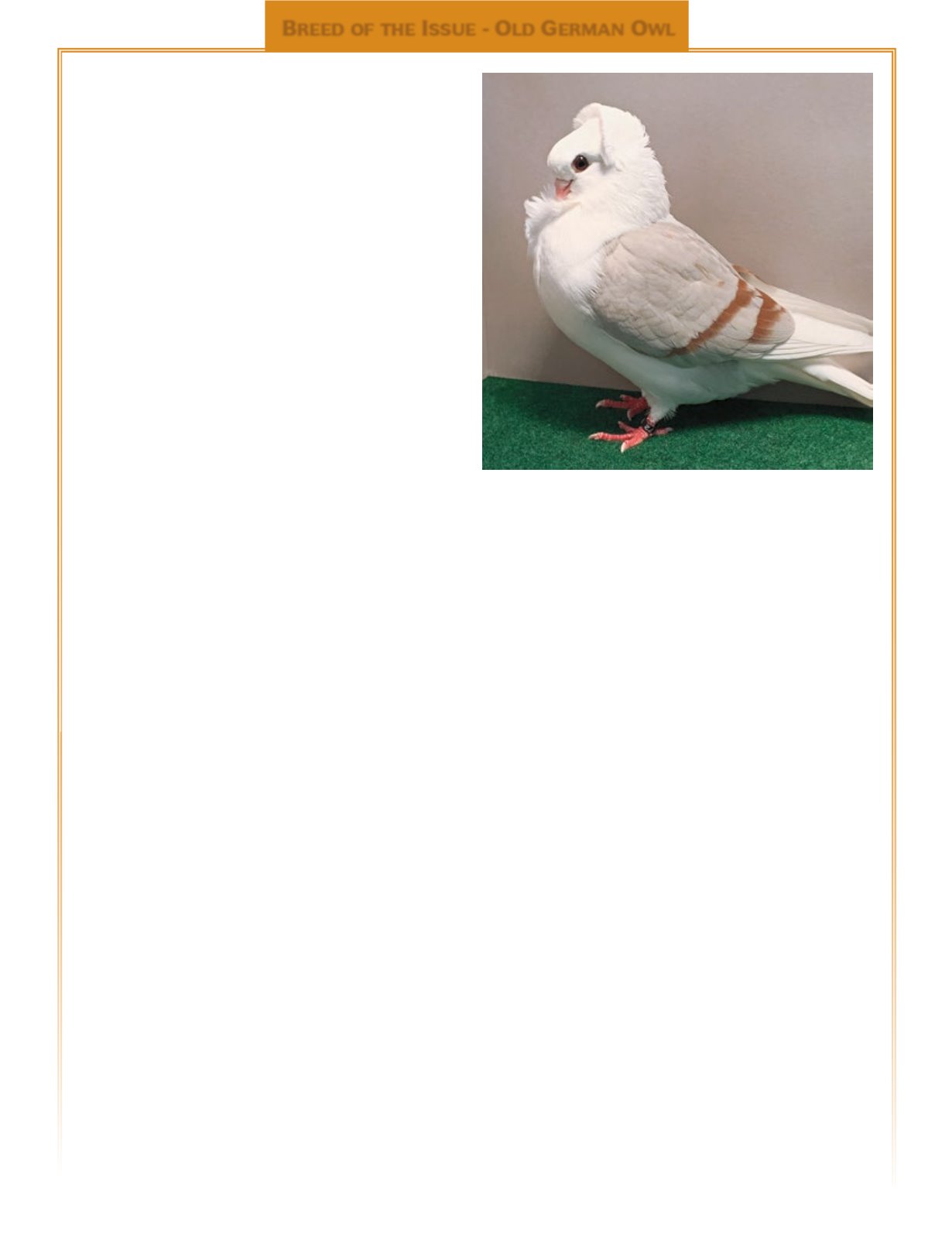
Bill Henderson’s 2019 NYBS Champion Old German Owl
#172 Red Bar Hen - entry of 184